Imagine, for a moment, it is 1994. You are sitting in a boardroom, and someone suggests that within two decades, every person in the world will carry a high-powered computer in their pocket that allows them to buy groceries, watch live television, and broadcast their thoughts to millions instantly. You’d likely have laughed them out of the room. Then came the iPhone in 2007. The “Smartphone Era” didn’t just change how we called our mothers; it fundamentally rewrote the DNA of marketing. It gave birth to social media advertising, influencer culture, and the “always-on” consumer.
Just as the smartphone acted as the catalyst that moved us from the desktop to the palm of the hand, we have now reached a similar “Day Zero.” As we look at the Gen 3 units beginning to roll off repurposed production lines in Fremont, it is time to discuss exactly how Tesla Optimus will change marketing. We are standing at the precipice of a shift that is just as seismic as the mobile revolution, and if you think this is just a win for manufacturing, you’re missing the biggest brand opportunity of the decade.
Here is why you need to wake up to the “Optimus Effect.”
What exactly is Optimus?
To understand the marketing potential, we first have to understand what Optimus actually is. Put simply, Optimus is a general-purpose, bi-pedal humanoid robot.
Think of it as a “Tesla on legs.” It doesn’t use pre-programmed tracks or “if-this-then-that” logic. Instead, it uses the same “Full Self-Driving” (FSD) computer and neural networks that power Tesla’s cars. It “sees” the world through cameras, processes the visual data in real-time, and learns tasks by observing humans.
If a traditional industrial robot is a high-speed dishwasher—great at one thing but useless at everything else—then Optimus is a human intern. It can be taught to fold a shirt, move a box, greet a customer, or hold a camera rig. It is the “Swiss Army Knife” of physical presence.
This year, we are looking at the Gen 2 and Gen 3 models. These units have achieved what engineers call “tactile sensing.” Their fingers have the dexterity to pick up an egg without cracking it, yet the strength to lift a 20kg crate. For a Brand Manager, this level of precision means the robot can handle your premium products with the same care as your best boutique staff.
How It Works
The magic isn’t in the metal; it’s in the training. Tesla uses “End-to-End Neural Networks.” This means the robot isn’t told “move joint A by 30 degrees.” It is shown a video of a human performing a task, and it figures out how to mimic that movement.
This is a game-changer for business owners. In the past, automation was expensive because it required specialised coding for every single move. Now, if you want Optimus to set up a display for a new fragrance launch, you don’t hire a coder; you simply show the robot how to do it once.
| Feature | Industrial Robots (Old Tech) | Tesla Optimus (New Tech) |
| Movement | Fixed/Bolted down | Mobile/Bi-pedal (Walks) |
| Programming | Millions of lines of code | Visual learning (Neural Nets) |
| Versatility | Single-task | Multi-task / General purpose |
| Cost | Millions (Custom built) | Expected mass-market pricing |
We aren’t just looking at better balance; we are looking at a $20,000–$30,000 asset that can learn your brand’s specific retail ‘dance’ simply by watching a video. For a business owner, this is the first time high-level automation has been this affordable and this adaptable.”
Why Marketers Should Care: Beyond the Warehouse
Most people hear “robot” and think “factory.” But for those of us in the business of persuasion and experience, the implications are far more creative.
1. Experiential Marketing: The Ultimate Brand Ambassador
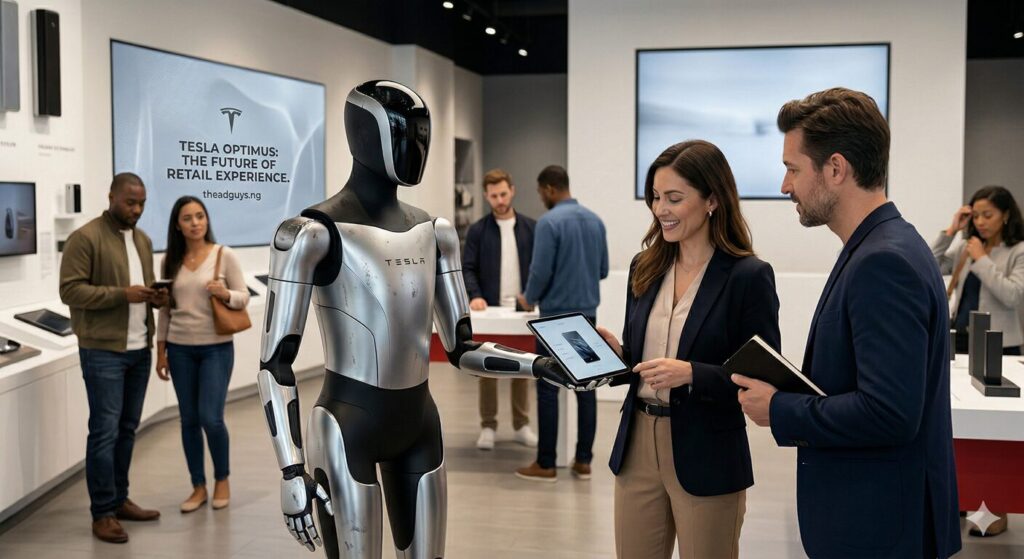
Imagine a product launch in London’s Covent Garden or a pop-up shop in Lagos. Instead of a hired hand in a branded t-shirt, you have an Optimus unit interacting with the crowd.
Unlike a stationary kiosk, Optimus can walk with a customer, demonstrate how a complex piece of tech works, and even use its integrated speakers to communicate your brand’s “voice” perfectly. It turns a simple purchase into a “must-share” social media moment.
2. Redefining Content Creation
One of the most expensive parts of high-end production is the “rigging”—the cranes, the dollies, and the steady-cam operators.
An Optimus unit can be programmed to act as a stabilised, mobile camera rig that can move in ways a human cannot. It can follow an athlete at a precise speed, hold a lighting bounce board at the perfect angle for ten hours straight, or act as a “physical” CGI marker on set. It’s the ultimate production assistant that never needs a lunch break or a union-mandated coffee stop.
3. Hyper-Personalised Retail – The “Phygital” Bridge
We’ve spent years trying to bridge the gap between “Physical” and “Digital” (Phygital). Optimus is the bridge.
In a high-end retail environment, an Optimus unit could recognise a VIP customer via facial recognition (with opted-in privacy protocols), remember their previous purchases, and physically lead them to a new collection they might like. It brings the data-driven precision of an Amazon algorithm into the tactile world of a brick-and-mortar store.
Overcoming the “Uncanny Valley”
As business owners and tech people, we must address the elephant in the room: the “creepy” factor. Humans have a natural aversion to things that look almost human but not quite—a phenomenon known as the Uncanny Valley.
However, Tesla has been smart. Optimus doesn’t have a fake human face or synthetic skin. It has a sleek, visor-like head that looks like something out of a high-end tech lab. It feels like “The Future,” not a “Fake Person.” This distinction is vital for Brand Managers. We aren’t trying to trick customers into thinking they are talking to a human; we are giving them a high-tech interaction with a machine that feels helpful, transparent, and approachable.
How to Prepare: A Checklist for Leaders
The commercial rollout is happening this year so you need to start thinking about the following:
- Robotic Presence Budgets: Just as you have a budget for “Social Media” or “TV,” you will soon need a line item for “Automated Physical Presence.”
- Brand Voice for AI: If your brand had a physical body and a voice, what would it sound like? How would it move? Start defining your “Robotic Brand Guidelines.”
- The Integration of Sales and Tech: Your Head of Sales and your CTO need to start talking. Optimus isn’t just a tool for the warehouse; it’s a tool for the showroom floor.
- Safety and Ethics: Ensure your growth hackers are thinking about the data privacy of customers interacting with these units in the wild.
The Bottom Line
Whether it’s helping a Growth Hacker scale a physical delivery service, assisting a Creative Director in capturing the perfect shot, or giving a Business Owner the ability to keep their shop open 24/7 with a friendly, autonomous host, the possibilities are limited only by our imaginations.
The future isn’t coming; it’s walking toward us at 5 miles per hour, and it’s carrying your brand’s logo. The question is: are you ready to hand over the keys?